
TFA cleavage reagent field guide
Blog post description.
7/25/20264 min read
Practical Notes for TFA Cleavage in Fmoc Solid-Phase Peptide Synthesis (SPPS)
The final TFA cleavage step is one of the most critical stages in peptide synthesis because it simultaneously removes the peptide from the resin and deprotects all side-chain protecting groups. The choice of cleavage cocktail, reaction time, and work-up conditions significantly influences crude purity, overall yield, and the formation of side products. Careful optimization at this stage often reduces purification time and improves recovery.
1. Preparation of the Resin
Before cleavage, the resin should be washed thoroughly with DMF, followed by DCM, to remove residual coupling reagents and solvents. The resin should then be dried under vacuum or under a stream of nitrogen for approximately 15–30 minutes. Residual DMF or DCM dilutes the cleavage cocktail, reducing cleavage efficiency and sometimes leading to incomplete removal of protecting groups.
2. Preparation of the Cleavage Cocktail
Always prepare the cleavage cocktail immediately before use. Several scavengers, especially EDT and DMS, gradually lose effectiveness upon prolonged exposure to air. Freshly prepared cocktails provide better protection against oxidation and produce more reproducible crude peptide quality.
Fresh, high-quality TFA should always be used. Moisture-contaminated TFA often results in slower cleavage kinetics and increased hydrolytic side reactions.
3. Cleavage Conditions
Use sufficient cleavage solution to completely immerse the resin. As a general guideline, 8–10 mL of cleavage cocktail per gram of resin provides efficient mixing and complete contact between the resin and reagents.
The reaction should be performed at room temperature (20–25°C). Heating is generally avoided because elevated temperatures accelerate methionine oxidation, tryptophan degradation, and peptide hydrolysis.
Gentle agitation using a shaker or overhead mixer ensures uniform exposure of the resin to the cleavage cocktail. Vigorous stirring should be avoided because it may fracture the resin beads and complicate filtration.
4. Optimizing Cleavage Time
Most peptides require 2–3 hours for complete cleavage. Longer reaction times do not necessarily improve deprotection and often increase undesirable side reactions.
For peptides containing acid-labile modifications or oxidation-sensitive amino acids such as methionine or tryptophan, monitor the reaction periodically by LC-MS after approximately two hours. Once complete deprotection is confirmed, terminate the reaction immediately rather than extending the cleavage unnecessarily.
5. Filtration and Peptide Precipitation
Following cleavage, remove the resin by filtration using a sintered glass funnel or PTFE syringe filter.
The peptide should then be precipitated by slowly adding the TFA solution into a large excess of ice-cold diethyl ether while stirring. Adding ether to the cleavage solution generally produces poorer precipitation and may lead to oil formation.
Allow the suspension to stand for several minutes before centrifugation to maximise peptide recovery.
Wash the resulting peptide pellet at least two or three times with cold ether to remove residual TFA, scavengers, and protecting group fragments.
Finally, dry the crude peptide under high vacuum before dissolution for HPLC purification.
Safety Considerations
TFA is highly corrosive and releases irritating vapours. All cleavage operations should be performed inside a certified chemical fume hood while wearing acid-resistant gloves, laboratory coat, and chemical splash goggles.
Phenol is readily absorbed through the skin and can cause severe chemical burns. Double nitrile gloves are recommended, and contaminated gloves should be replaced immediately.
EDT, thioanisole, and dimethyl sulfide possess extremely strong odours and are respiratory irritants. Containers should remain tightly sealed except during dispensing, and work should always be conducted under efficient ventilation.
Diethyl ether is highly flammable and forms explosive peroxides during storage. Keep ether away from ignition sources and always use freshly opened solvent or peroxide-tested material.
DCM is volatile and potentially carcinogenic. Avoid prolonged inhalation exposure and minimise skin contact.
All waste containing TFA, sulfur-containing scavengers, or chlorinated solvents should be collected separately and disposed of according to institutional hazardous waste procedures.
Troubleshooting Guide
Incomplete Side-Chain Deprotection
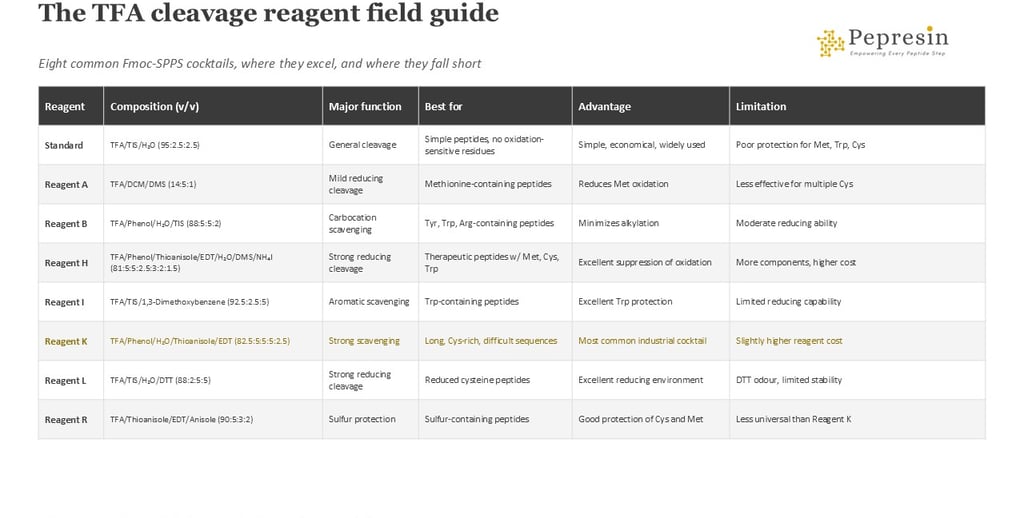
If LC-MS indicates incompletely deprotected peptide, the cleavage time was probably insufficient or the scavenger composition was inadequate for the sequence. An additional 30–60 minutes of cleavage using fresh cocktail usually resolves the problem. For Arg(Pbf)-rich peptides, Reagent K or Reagent H often provides more efficient deprotection than the standard TFA/TIS/H₂O cocktail.
Methionine Oxidation (M+16)
Methionine oxidation is among the most common impurities encountered during TFA cleavage. It is typically caused by dissolved oxygen, prolonged cleavage times, or inadequate reducing scavengers.
This problem can usually be minimised by using Reagent H or a cleavage cocktail containing thioanisole, DMS, EDT, or NH₄I. Limiting air exposure and avoiding unnecessary reaction times are equally important.
Tryptophan Oxidation
Tryptophan residues are highly susceptible to oxidation and electrophilic substitution under strongly acidic conditions.
Phenol and thioanisole significantly reduce tryptophan degradation. Cleavage should be performed under subdued light whenever fluorescent modifications are also present.
Cysteine Oxidation
If cysteine-containing peptides exhibit disulfide formation or oxidation during cleavage, increase the concentration of EDT or employ Reagent K. Air exposure during filtration and precipitation should also be minimised.
Low Crude Purity
Poor crude purity is often caused by oxidation, incomplete deprotection, peptide aggregation, or inappropriate cleavage cocktail selection.
Rather than simply extending the cleavage time, optimise the scavenger composition according to the peptide sequence. Many difficult peptides benefit substantially from changing from the standard cocktail to Reagent K or Reagent H.
Low Peptide Recovery
Incomplete precipitation is common for highly hydrophilic peptides.
Increasing the ether volume, cooling the precipitation mixture to approximately −20°C, and allowing the suspension to stand before centrifugation generally improves recovery.
Highly hydrophobic peptides may instead form sticky oils rather than solid pellets. In these cases, methyl tert-butyl ether (MTBE) or hexane may provide better precipitation than diethyl ether.
Poor HPLC Peak Shape
Residual TFA, phenol, thioanisole, or other scavengers frequently cause distorted chromatographic peaks.
Additional ether washing followed by complete vacuum drying usually eliminates these problems before preparative purification.
Practical Tips from Industrial Peptide Process Development
One of the most effective strategies in industrial peptide chemistry is to perform a small-scale cleavage optimisation before processing the entire batch. Cleaving 5–10 mg of resin using two or three different cleavage cocktails allows rapid evaluation of crude purity by LC-MS and analytical HPLC, helping to identify the optimal conditions before committing valuable material.
The cleavage cocktail should always be selected based on the peptide sequence rather than using a universal formulation. For simple peptides, TFA/TIS/H₂O is often sufficient. Peptides containing methionine generally benefit from Reagent H, while cysteine-rich or long therapeutic peptides usually produce cleaner crude material with Reagent K. This sequence-specific approach is standard practice in industrial process development and frequently results in higher crude purity, improved recovery, and a simpler downstream purification process.
Reference:
Sinenhlanhla N. Mthembu, Amit Chakraborty, Ralph Schönleber, Fernando Albericio, Beatriz G. de la Torre; TFA Cleavage Strategy for Mitigation of S‑tButylated Cys-Peptide Formation in Solid-Phase Peptide Synthesis. Org. Process Res. Dev. 21 March 2025; 29 (3): 691–703. https://doi.org/10.1021/acs.oprd.4c00443