
Best 5 Conditions for Disulfide Cyclization in Peptides
1/6/20261 min read
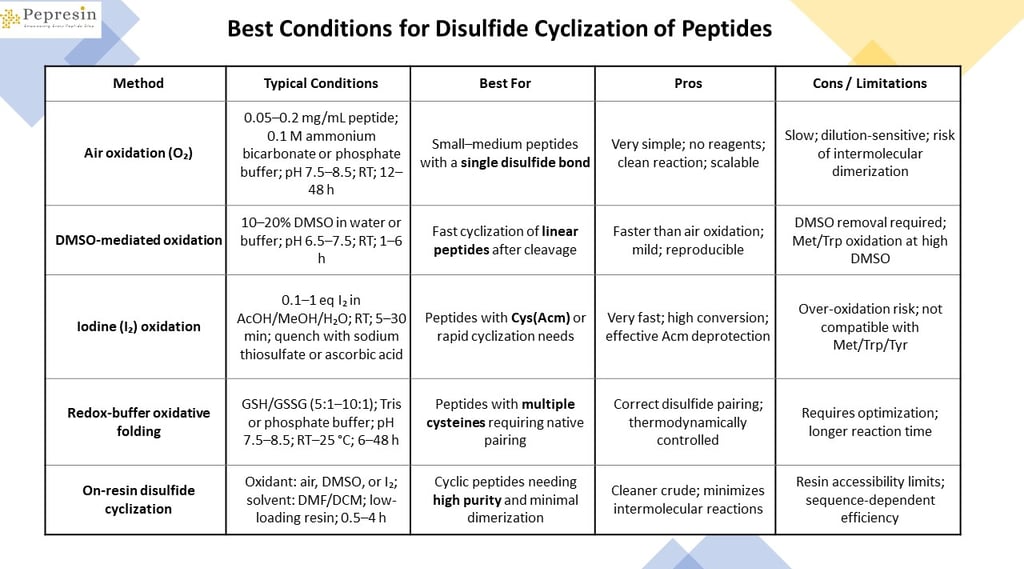
1️⃣ Air Oxidation (Oxygen-Mediated)
⭐ Most commonly used, simplest approach
Typical conditions
Peptide concentration: 0.05–0.2 mg/mL
Buffer: 0.1 M ammonium bicarbonate or phosphate
pH: 7.5–8.5
Temperature: RT
Time: 12–48 h
Best for
Small to medium peptides
Single disulfide bond
Clean sequences without aggregation issues
Pros
No reagents
Very clean reaction
Easy scale-up
Cons
Slow
Inefficient for sterically hindered peptides
Expert tip:
Dilution is critical to avoid intermolecular dimerization.
2️⃣ DMSO-Mediated Oxidation
⭐ Fast and very popular in SPPS workflows
Typical conditions
Solvent: 10–20% DMSO in water or buffer
pH: 6.5–7.5
Temperature: RT
Time: 1–6 h
Best for
Cyclization immediately after cleavage
Hydrophobic peptides
Lab-scale synthesis
Pros
Faster than air oxidation
Mild and controllable
Minimal side reactions
Cons
DMSO removal needed before purification
Expert tip:
Avoid >20% DMSO to prevent peptide oxidation at Met/Trp.
3️⃣ Iodine (I₂) Oxidation
⭐ Fastest and most decisive method
Typical conditions
Solvent: Acetic acid / MeOH / water
I₂: 0.1–1 eq
Temperature: RT
Time: 5–30 min
Best for
Cys-protected peptides (Acm, Trt removal)
Time-sensitive workflows
Pros
Extremely fast
High conversion
Cons
Can oxidize Met, Trp, Tyr
Requires quenching (ascorbic acid or thiosulfate)
Expert tip:
Monitor by LC–MS closely; overoxidation happens quickly.
4️⃣ Oxidative Folding (Redox Buffer System)
⭐ Best for complex or bioactive peptides
Typical conditions
Redox pair: GSH / GSSG (5:1 to 10:1)
Buffer: Tris or phosphate
pH: 7.5–8.5
Temperature: RT–25°C
Time: 6–48 h
Best for
Multiple cysteines
Correct native disulfide pairing
Therapeutic peptides
Pros
Thermodynamically controlled
Minimizes mispaired disulfides
Cons
Longer reaction time
Optimization required
Expert tip:
Add 0.5–2 M arginine if aggregation is observed.
5️⃣ On-Resin Disulfide Cyclization
⭐ Excellent for improving purity
Typical conditions
Oxidant: I₂, DMSO, or air
Solvent: DMF or DCM
Resin: Wang / Rink amide
Time: 30 min–4 h
Best for
Head-to-tail or constrained cyclic peptides
Preventing dimer formation
Pros
Cleaner crude peptide
Reduced intermolecular reactions
Cons
Resin accessibility matters
Not suitable for all sequences
Expert tip:
Use low-loading resin to improve cyclization efficiency.